Table of Contents
Introduction
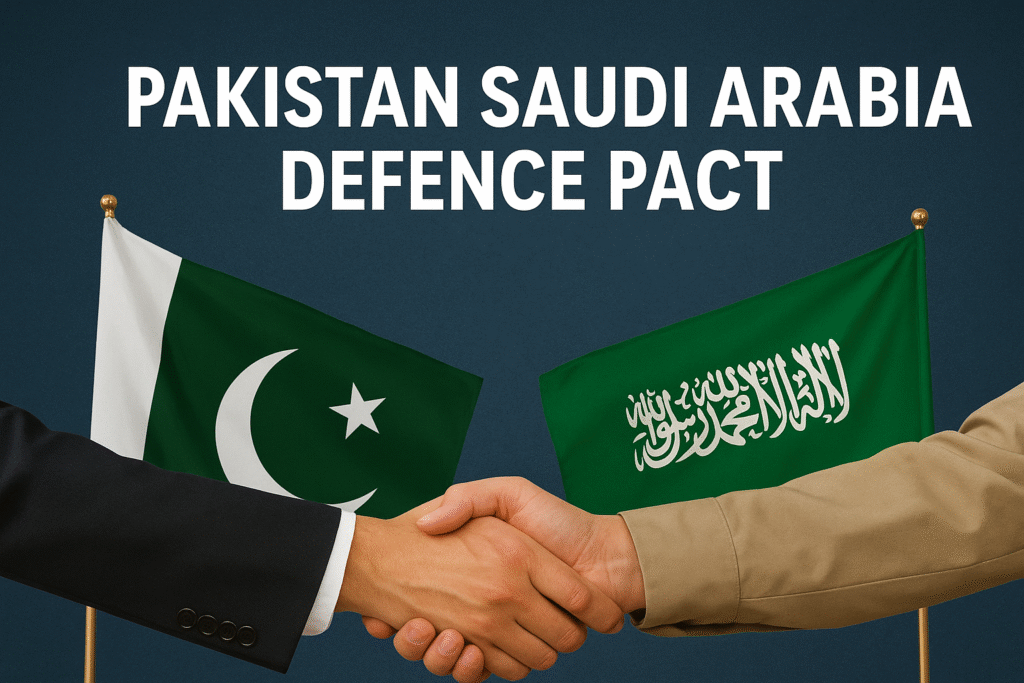
The Pakistan Saudi Arabia defence pact marks a turning point in regional geopolitics. Signed as a framework of strategic cooperation, the pact outlines commitments to mutual defence, joint deterrence, and closer military collaboration between the two Muslim-majority nations. With both countries historically tied by religious, cultural, and economic bonds, this defence partnership adds a new layer of strategic depth.
Historical Context
Pakistan and Saudi Arabia share decades of close relations. Riyadh has often supported Islamabad during economic crises, while Pakistan has historically contributed troops and expertise to bolster Saudi defence. Over the years, their security cooperation has expanded from training programs to joint military exercises. The new pact builds on these foundations, institutionalizing military commitments in the face of evolving regional challenges.
Key Provisions of the Defence Pact
- Mutual Defence Clause: The pact emphasizes that aggression against one state will be treated as aggression against both.
- Joint Security Cooperation: Establishing mechanisms for intelligence sharing, counter-terrorism strategies, and rapid-response frameworks.
- Strategic Ambiguity: While the pact avoids explicit reference to nuclear deterrence, analysts note its implications for Pakistan’s nuclear umbrella.
Strategic Motivations Behind the Pact
- Regional Instability: Heightened tensions in the Middle East, particularly with Iran and ongoing conflicts, push Saudi Arabia to broaden its security guarantees.
- Saudi Arabia’s Defence Diversification: While traditionally reliant on the U.S., Riyadh seeks additional partners to reduce dependence.
- Pakistan’s Strategic Gain: Islamabad benefits from deeper ties with the Gulf powerhouse, strengthening its geopolitical leverage and securing potential economic dividends.
Implications and Impact
- For Pakistan: Enhances its strategic stature and bolsters its deterrence posture, while potentially drawing it into Middle Eastern security dilemmas.
- For Saudi Arabia: Strengthens its deterrent capabilities and signals independence from Western security guarantees.
- For Neighbours: India, Iran, and Gulf states are carefully monitoring the pact, assessing its impact on the regional balance of power.
- For Global Powers: The U.S., China, and Russia may recalibrate their Middle East and South Asia policies in response to the new security equation.
Challenges and Risks
- Operational Hurdles: Coordinating command structures and logistics across two distant militaries will be complex.
- Nuclear Ambiguity: The absence of clarity on nuclear dimensions may create misperceptions.
- Regional Backlash: Iran, in particular, may view the pact as a direct threat, fueling further tension.
Global and Regional Repercussions
The pact reshapes not only South Asian security dynamics but also Middle Eastern defence alignments. It could intensify the regional arms race, shift alliance structures, and influence diplomatic negotiations. Moreover, it raises critical questions for countries dependent on Gulf security architecture.
Conclusion
The Pakistan Saudi Arabia defence pact is more than a bilateral agreement—it is a statement of intent. It symbolizes the convergence of strategic interests between Islamabad and Riyadh, while also posing fresh challenges to regional stability. Moving forward, the world will watch how both nations operationalize this pact, and whether it becomes a stabilizing force or a catalyst for new tensions.
FAQs on the Pakistan Saudi Arabia Defence Pact
What is the Pakistan Saudi Arabia defence pact?
The Pakistan Saudi Arabia defence pact is a mutual defence agreement where both nations have pledged to support each other against external aggression, enhance joint military cooperation, and strengthen regional security.
When was the Pakistan Saudi Arabia defence pact signed?
The pact was signed in 2025, formalizing decades of close military ties between the two countries.
Why did Pakistan and Saudi Arabia sign a defence pact?
The defence pact was signed to address regional instability, enhance deterrence, and ensure joint security in response to evolving threats in South Asia and the Middle East.
Does the defence pact include nuclear deterrence?
While the agreement avoids explicitly mentioning nuclear cooperation, analysts note the strategic ambiguity could imply an extension of Pakistan’s nuclear deterrence to Saudi Arabia.
How does the pact affect India and Iran?
For India, the pact signals Pakistan’s growing military alliances, while for Iran, it raises concerns over regional balance and Saudi security policies. Both countries are closely monitoring the pact’s implications.
How will the Pakistan Saudi Arabia defence pact impact the Middle East?
The pact could reshape Middle East alliances, intensify the regional arms race, and influence global powers like the U.S., China, and Russia in recalibrating their strategies.
What are the challenges in implementing the Pakistan Saudi Arabia defence pact?
Challenges include operational logistics, command coordination, and managing diplomatic backlash from regional rivals.